
Chef in the Making
Official name: National Certificate: Professional Cookery, NQF 4 (learnership)
A national qualification for people who want a career in a professional kitchen. Learn food safety, kitchen skills and every major cooking method, then build your skills on real shifts at a host kitchen.
QualificationNational Certificate, NQF 4
Credits145
FormatLearnership: classroom + workplace
CATHSSETA-accredited provider 613/P/00381/2022 · National qualification · Classroom + workplace · SETA grants for employers
Why this course
A qualification kitchens recognise
Hotels, lodges and restaurants need cooks who work safely, cleanly and to a standard. This is the qualification that proves you can.
A national qualification
SAQA ID 14111, NQF Level 4
A registered National Certificate with 145 credits, not just a course certificate.
Real kitchen hours
Theory and a host kitchen
Your learnership includes work in a real kitchen, recorded in a logbook and signed off.
A career path
From cook to chef
Professional cookery is the first step towards chef de partie, sous chef and head chef.
The outcome
What you will be able to do
By the end of the learnership you can do each of these in a working kitchen.
Keep food safe and hygienic from delivery to plate
Receive, check and store food deliveries correctly
Use and look after kitchen equipment safely
Prepare and cook using many different cooking methods
Store, issue and rotate stock so nothing goes to waste
Communicate clearly with your team and with guests
Do the everyday maths of a kitchen: portions, costs and conversions
Coach and support new staff in the kitchen
Give basic first aid when someone is hurt
Plan your own development and next career step
A service, step by step
How a kitchen shift runs
These are the skills you practise on every shift.
1 · Deliveries
Receiving deliveries
Check what arrives against the order, check temperatures and quality, and store it straight away in the right place.
Kitchen tipLabel and date everything you put away.
2 · Mise en place
Mise en place
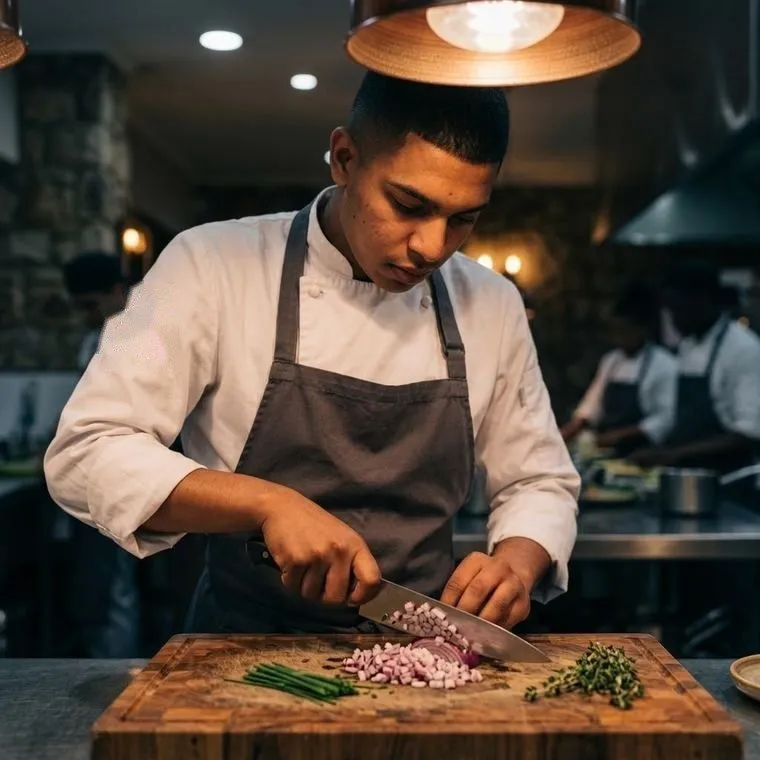
Everything in its place: weigh, cut and prepare ingredients before service starts, so cooking is fast and calm.
Kitchen tipA tidy station is a safe station.
3 · Cooking
Cooking to order
Use the right method for each dish, from boiling and poaching to roasting, grilling, frying and baking.
Kitchen tipTaste as you go.
4 · Plating
Plating
Plate each dish the same way every time, hot food hot and cold food cold.
Kitchen tipWipe the rim of every plate before it leaves.
5 · The pass
Sending it out
Check each plate at the pass before the waiter takes it to the guest.
Kitchen tipIf you would not serve it to your family, do not send it.
6 · Clean down
Cleaning down
Clean and sanitise your station and equipment, store leftovers safely and hand over to the next shift.
Kitchen tipClean as you go, not only at the end.
What you learn
10 modules, three parts
Open any module to see what it covers.
10 modules
145 credits
16 practical kitchen sessions
28 recipe cards
Part 1
Working in hospitality
Introduction to hospitality
Customer service, the hospitality and tourism sectors, your workplace layout, hygiene and professional appearance.
Communication, culture and relationships
Speaking with guests and colleagues, cultural awareness and working relationships.
Writing, telephone and calculations
Written messages, telephone calls and the basic calculations a kitchen needs.
Part 2
In the kitchen
Food safety and hygiene
Hygiene in food preparation, cooking and storage, and a safe, clean kitchen.
Goods and equipment
Accepting deliveries, using and caring for kitchen equipment and tools.
Cooking methods
Boiling, poaching, steaming, roasting, grilling, frying, baking and more, with practical dishes.
Receiving, storing and issuing goods
Stock control, storage and issuing ingredients to the kitchen.
Part 3
Growing as a cook
Coaching and development
Coaching others on the job and planning your own development.
Employment opportunities
Finding work, self-employment options and planning your career.
First aid
Giving basic first aid in the workplace.
Talk like a cook
Words you will use every shift
The words you will hear on the job.
Mise en place
French for "everything in its place". All the preparation you do before service.
The pass
The counter where finished plates are checked before they go out to guests.
FIFO
First in, first out. Use older stock before newer stock.
Danger zone
The temperature range where bacteria grow fastest. Keep hot food hot and cold food cold.
Brigade
The team of a kitchen, from commis cook up to head chef.
Sanitise
Clean a surface so that germs are killed, not only wiped away.
Ready to start? Leave your number and we call you back.
Quick check
Is this course for you?
Ask yourself these three questions.
Do you enjoy cooking for other people?
Can you work fast and stay calm under pressure?
Do you want a career in a professional kitchen?
Three yeses? This course is for you.
How it works
From first call to certificate
EnquireLeave your number. We explain how the learnership works and who can join.
RegistrationWe register the learnership with CATHSSETA and sign the agreements.
ClassroomTheory lessons with your facilitator, module by module.
WorkplacePractical work at a host employer, recorded in your logbook.
Assessment & certificateAssessment and moderation. Competent learners receive the National Certificate.
How you are assessed
Practical tasks
You cook and plate dishes while your assessor observes.
Knowledge tests
Written assessments for each module, with practice first.
Workplace logbook
Your host kitchen signs off the tasks you do on real shifts.
Included in the course
Everything you need
Learner guides for every module
Practical kitchen sessions with recipe cards
A host kitchen for your workplace hours
A workplace logbook
A facilitator and assessor who check your progress
What you leave with
Proof you can do the job
National CertificateProfessional Cookery, NQF Level 4, 145 credits, if found competent.
Signed logbookProof of the work you did in a real kitchen.
Kitchen confidenceThe habits of a professional cook: clean, safe, organised and fast.
Where it can take you
Your career ladder
These are the usual steps in a professional kitchen.
Cook or commis chefHotels, lodges, restaurants, catering companies and guest houses.
Chef de partieRun one section of the kitchen, such as grill, sauces or pastry.
Sous chefSecond in charge: run the kitchen when the head chef is away.
Head chefPlan menus, lead the brigade and manage the kitchen.

Questions
Before you enrol
Still unsure? Call or WhatsApp +27 62 495 8450.
What is a learnership?
A structured programme that combines classroom learning with work at a host employer, and leads to a registered national qualification.
Do I need experience?
No. The learnership starts with the basics of hospitality and food safety and builds up from there.
What certificate do I get?
Learners who are found competent receive the National Certificate (SAQA ID 14111, NQF Level 4, 145 credits). Injongo is accredited by CATHSSETA to offer it (613/P/00381/2022).
How is a learnership funded?
Learnerships are usually run with an employer or sponsor, often with SETA support. When you enquire, we tell you which funded places are open.
What does an employer get?
Registered learnerships can qualify for SARS learnership allowances, B-BBEE skills development points and CATHSSETA grants. We handle the paperwork with you.
Where is the training?
In Jeffreys Bay, Knysna, George, Plettenberg Bay, Oudtshoorn, Cape St Francis and Mossel Bay, or on site at your workplace for employer groups.
Keep exploring
Courses that go well with this one
Kitchen & cooking
Quick Kitchen Cook
Kitchen & cooking
Kitchen Kick-Start
Restaurant, bar & coffee
Restaurant Service Pro
Enquire now
We call you back to explain how the learnership works and who can join.
Training with a purpose.
Contact
+27 62 495 8450
WhatsApp us
[email protected]
29 Da Gama Road, Jeffreys Bay
Injongo College is the trading name of Injongo FET College (Pty) Ltd, reg. 2017/439489/07. CATHSSETA-accredited skills development provider 613/P/00381/2022. DHET-registered private college 2023/FE07/012 for NC(V) programmes. Training in Jeffreys Bay, Knysna, George, Plettenberg Bay, Oudtshoorn, Cape St Francis and Mossel Bay.